
Open-source contribution
PyNE
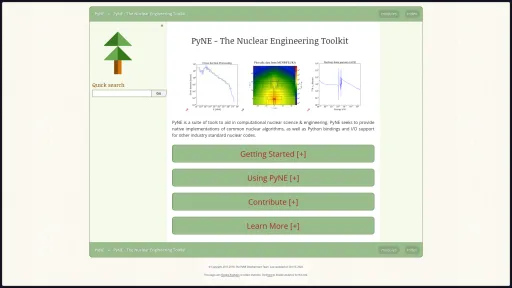
Contributions to PyNE, the Nuclear Engineering Toolkit — the Python layer that many simulation workflows use to assemble decks, run codes and read results.
- Role
- Open-source contributor
- Period
- 2023 — present
The problem
PyNE sits between Python users and compiled physics codes, translating between deck files, run directories and result objects. Every one of those translations is a place where a value can quietly change meaning.
The approach
My contributions focused on the Python-facing behaviour of the toolkit: the API surface users script against, and the deck/result plumbing that keeps a run reproducible when it is driven from Python rather than from the command line.
Working on PyNE also shaped Nucleide directly. Seeing which parts of the legacy stack were worth keeping — and which were better rewritten in Rust — is what gave that project its scope.
Engineering highlights
Feeding the rewrite
PyNE was the reference implementation Nucleide validates against. Contributing to the old stack is how the scope of the new one was defined.
Reproducibility through the API
Driving a run from Python is where reproducibility is won or lost: the deck, the inputs and the results have to travel together.
At a glance
- Project
- The Nuclear Engineering Toolkit
- Role
- Contributor
Stack
- Python
- Cython
- C++
- NumPy
- SciPy